
Free Advanced Excel & Power BI Workshop
Join COSENG for a completely free, hands-on data analytics workshop. This session is designed to give you a practical preview of how data can drive smarter business decisions.
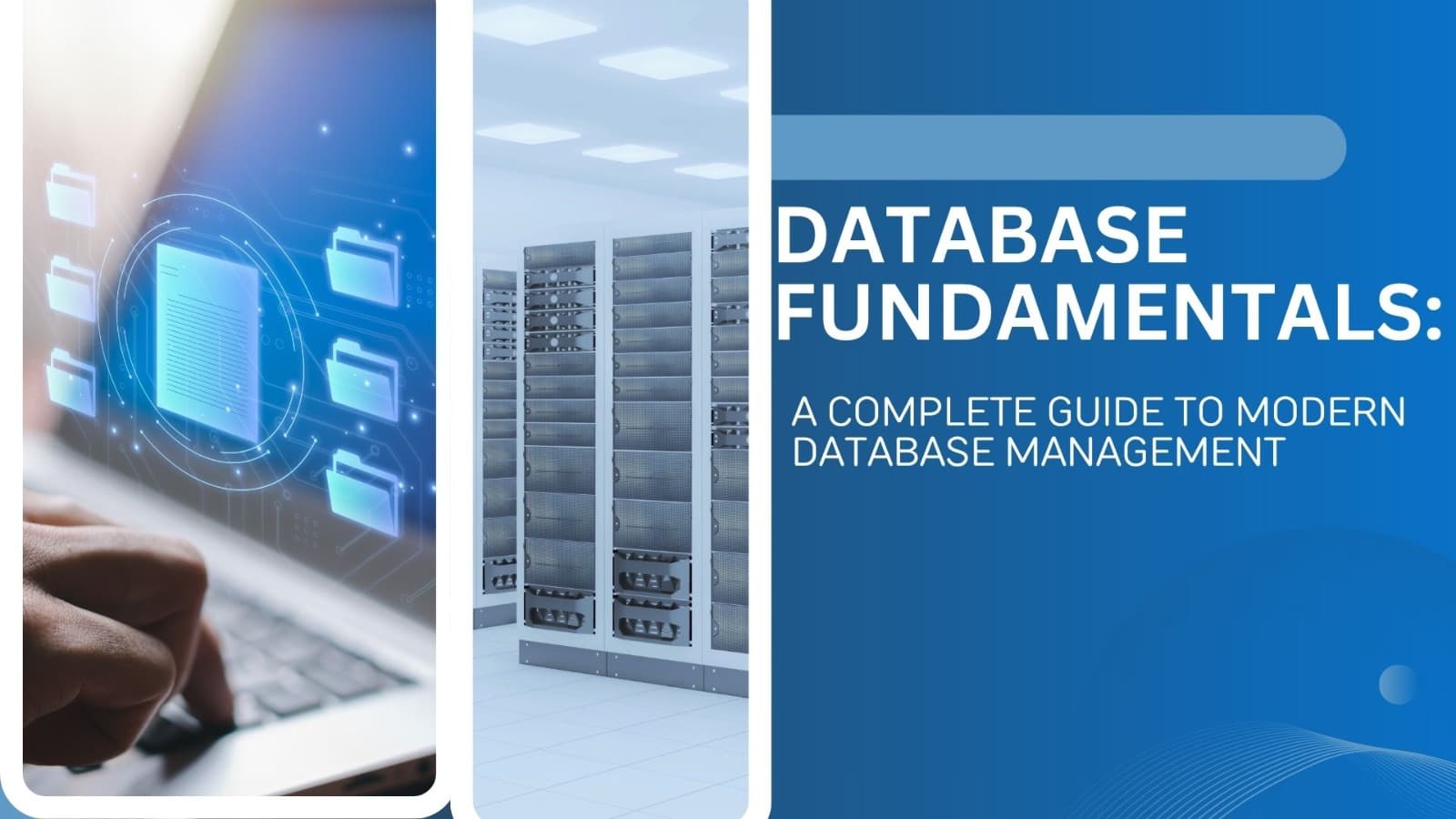
Database Fundamentals: A Complete Guide to Modern Database Management
Coseng Limited |
Posted on: Mon, Jun 8, 2026
Data is the most valuable resource of the 21st century. Understanding how it is stored, organised, and retrieved is no longer a niche technical skill — it is a core professional competency for anyone operating in today's digital economy. Whether you are a business analyst, software developer, IT manager, or simply someone eager to future-proof your career, mastering database fundamentals gives you a decisive edge. This guide from Coseng Limited breaks down everything you need to know — from foundational concepts to emerging trends — in a clear, practical, and inspiring way.
At its core, a database is an organised collection of structured information stored electronically and managed by specialised software. Think of it as the intelligent backbone behind every digital experience you encounter. When you log into your bank account, stream a film, place an online order, or check your medical records — a database is working behind the scenes, retrieving exactly the right information in milliseconds. Without databases, modern business, healthcare, finance, and communication as we know them simply could not exist.
A complete database system comprises three interconnected layers: the Data itself — the raw information being stored; the Database Management System (DBMS) — the software engine that organises, protects, and provides access to the data; and the Applications — the front-end tools and interfaces through which users interact with the data. Together, these layers create a powerful, scalable infrastructure capable of supporting everything from a small business catalogue to a global financial network processing millions of transactions per second.
The Database Management System is the engine at the heart of every database operation. Far more sophisticated than a simple spreadsheet or flat file, a DBMS provides a structured, secure, and efficient environment for managing data at any scale. A robust DBMS handles several mission-critical responsibilities: Data Storage Management, which determines how data is physically written to and retrieved from disk; Access Control and Security, which enforces granular permissions; Concurrent Multi-User Access, enabling thousands of simultaneous users without conflicts; Backup and Recovery to safeguard against failure; and Query Processing, which interprets and executes requests with precision and speed.
When learning database management, you will encounter three primary types of DBMS architecture. Relational DBMS (RDBMS) — the gold standard for structured data, including MySQL, PostgreSQL, Oracle, and Microsoft SQL Server — is ideal for transactional systems requiring strict consistency. NoSQL DBMS, designed for flexibility and scale, includes MongoDB, Apache Cassandra, and Redis, and is ideal for big data and real-time applications. In-Memory DBMS stores data directly in RAM, delivering extraordinarily fast access speeds for caching, session management, and high-frequency trading systems. Choosing the right DBMS is not just a technical decision — it is a strategic one that shapes the performance, scalability, and maintainability of your entire application.
Regardless of which DBMS you use, certain foundational concepts apply universally. In a relational database, data is organised into tables — each representing a distinct entity such as Customers, Products, or Orders. Columns define specific attributes, while rows represent individual records. Keys are the connective tissue of this structure: a Primary Key is a unique identifier assigned to every row, guaranteeing data uniqueness, while a Foreign Key links two tables by referencing a primary key in another, enabling relationships without duplicating data.
Databases model real-world relationships in three ways: One-to-One (one employee, one National Insurance number), One-to-Many (one customer, many orders), and Many-to-Many (many students enrolled in many courses, managed through a joining table). Communication with a database is done through queries — precise instructions written in SQL (Structured Query Language). SQL is the universal language of the data world and is consistently ranked among the most in-demand technical skills globally.
Data is only as valuable as it is reliable. A database filled with errors, duplicates, or inconsistencies is not just unhelpful — it is actively dangerous. In financial systems, corrupted data can mean regulatory violations. In healthcare, it can put lives at risk. Data integrity is therefore not optional; it is non-negotiable.
A well-architected DBMS enforces data integrity through three core mechanisms. Constraints are rules applied at the database level to prevent invalid data from being stored — a Price column might reject negative values, or an Email field might enforce a valid format. Normalisation is the process of structuring a database to reduce redundancy: instead of recording a customer's address on every single order, you store it once and reference it via a foreign key. Finally, ACID Transactions guarantee that operations either complete fully or not at all, through four properties — Atomicity, Consistency, Isolation, and Durability — ensuring data remains safe even during system failures. ACID compliance is what makes relational databases the trusted choice for banking, healthcare, and e-commerce systems worldwide.
One of the most consequential decisions a database architect makes is choosing between relational (SQL) and non-relational (NoSQL) systems. Relational databases use structured tables with fixed schemas and excel at complex transactions, data integrity, and financial systems — though they scale vertically and can be harder to distribute. Non-relational databases offer dynamic schemas and horizontal scalability, making them ideal for big data, real-time applications, and IoT platforms, though they often trade some consistency for speed and flexibility.
In practice, many modern enterprises operate polyglot persistence architectures — using multiple database types in parallel, each serving the purpose it excels at. The right choice depends entirely on your use case, data structure, and scalability requirements. A complex banking system demands a relational approach; a real-time social feed benefits from NoSQL. Understanding both gives you the strategic clarity to architect systems that perform at any scale.
The path from beginner to confident database professional is well-defined. Start by mastering SQL fundamentals — SELECT, INSERT, UPDATE, and DELETE are the four operations that power nearly every database interaction in the world. Follow this by studying database design principles: learn normalisation and Entity-Relationship Diagrams (ERDs), and always design your structure on paper before writing a single line of code. Next, install free tools such as MySQL Workbench, PostgreSQL, or SQLite and practise hands-on — real experience is irreplaceable. Then build a live project: a personal expense tracker or library catalogue will teach you how data flows from the user interface to the database and back. Finally, explore cloud and NoSQL environments — experiment with AWS RDS, MongoDB Atlas, or Azure SQL. The industry is cloud-first, and getting comfortable early is a significant career advantage.
The professionals who will define the next decade of technology are those who combine data literacy with business acumen. Starting with database fundamentals is the single most high-leverage investment you can make in your career today.
The database landscape is evolving at an unprecedented pace, yet the professionals who thrive will always be those grounded in the fundamentals — because new tools are built upon timeless principles. The industry has shifted decisively towards cloud-native databases: platforms such as Amazon RDS, Google Cloud SQL, Azure Database Services, and Snowflake eliminate the burden of physical infrastructure management, offer elastic scalability, and reduce total cost of ownership dramatically.
Artificial intelligence is transforming database administration, with modern DBMS platforms now featuring autonomous self-tuning capabilities — automatically optimising query plans, adjusting indexing strategies, and predicting hardware failures. Distributed and edge databases are spreading data intelligently across geographic locations, powering autonomous vehicles, smart factories, and real-time fraud detection. Perhaps most significantly, vector databases — designed to store and query the high-dimensional representations that underpin machine learning models — are becoming core infrastructure for intelligent applications. As generative AI becomes embedded in enterprise workflows, platforms like Pinecone, Weaviate, and Chroma are defining the next frontier of data architecture. The future belongs to those who understand not just how to use data — but how to architect, protect, and extract meaning from it at scale.
A database system is essential because it enables secure, scalable, and consistent data management that simple files or spreadsheets cannot provide — particularly when handling thousands of concurrent users or millions of records. Begin learning with tables, primary and foreign keys, relationships, and the four basic CRUD operations (Create, Read, Update, Delete), as these underpin virtually every database interaction. With consistent, structured study, most professionals develop strong foundational proficiency within three to six months — though mastery is a career-long journey with a far more accessible entry point than many assume.
SQL remains the most universally used database language in the world, listed in more job descriptions than virtually any other technical competency — learning it is not optional, it is foundational. As for choosing between SQL and NoSQL: relational databases suit complex, consistent transactions, while non-relational databases handle high-volume, unstructured data at scale. Many modern architectures wisely use both in parallel. Coseng Limited delivers professional data, analytics, and technology training for individuals and organisations across the UK and beyond. Visit www.coseng.co.uk or contact us at info@coseng.co.uk to begin your journey.
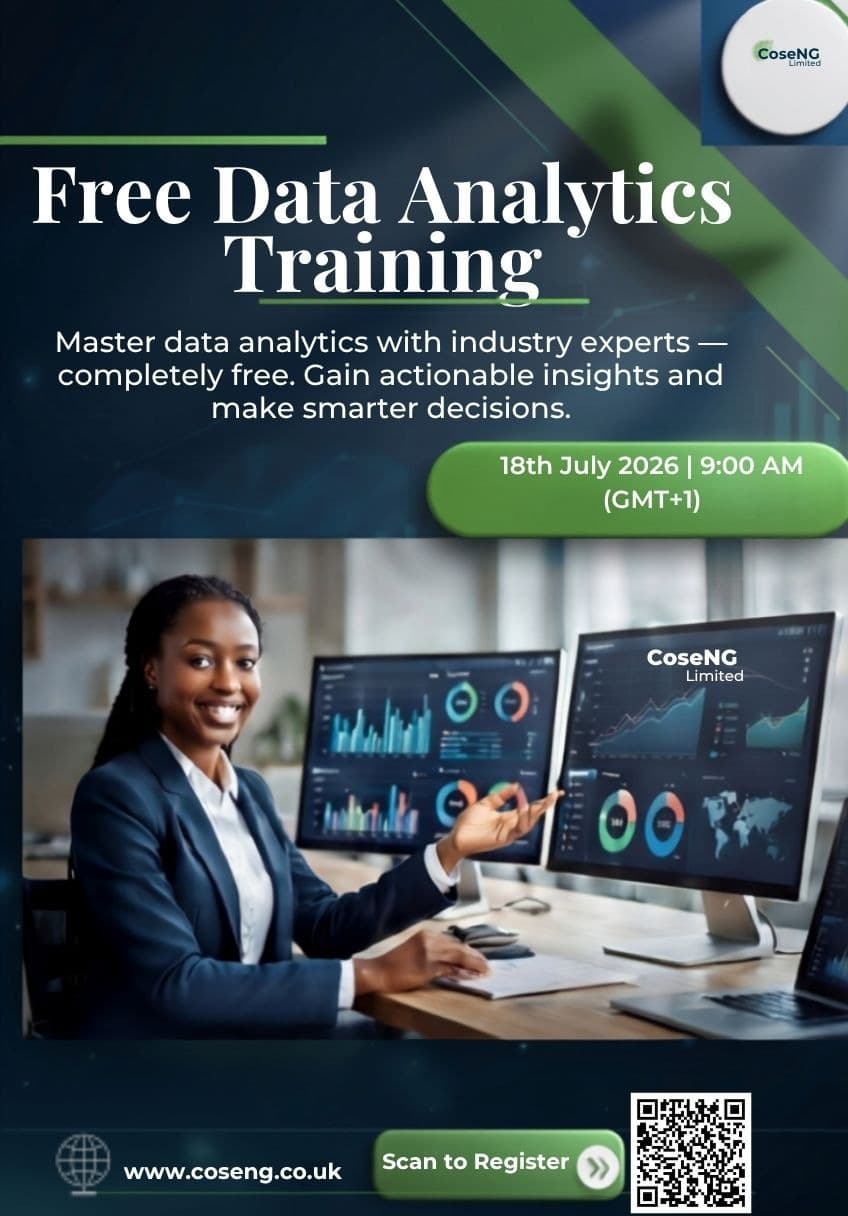
Join COSENG for a completely free, hands-on data analytics workshop. This session is designed to give you a practical preview of how data can drive smarter business decisions.

A free, hands-on introductory workshop to experience advanced Excel and Power BI. Get a practical preview of data modeling, dashboards, and reporting before joining a full program.

Looking to sharpen your Excel and Power BI skills? This six-week masterclass is tailored for professionals and business owners in Nigeria who want to automate reporting, handle large datasets, and create dashboards that drive smarter decisions.